Journal's Special Issue Highlights New Frontier of X-ray Lasers
A special issue of a physics publication highlights the contributions of SLAC's X-ray laser and the few similar lasers around the globe in probing the interaction of light and matter at the scale of atoms and electrons.
By Glenn Roberts Jr.
A special issue of a physics publication highlights the contributions of SLAC's X-ray laser and the few similar lasers around the globe in probing the interaction of light and matter at the scale of atoms and electrons.
The Journal of Physics B: Atomic, Molecular and Optical Physics issue, "Frontiers of free-electron laser science," features a summary of the early scientific results achieved with SLAC's Linac Coherent Light Source (LCLS) X-ray free-electron laser (XFEL), as well as five papers that present results from specific LCLS experiments.
The LCLS overview paper, prepared by SLAC Senior Staff Scientist Christoph Bostedt and several co-authors, also details several planned upgrades, including new instruments and a planned expansion that will multiply the volume of experiments and broaden the capabilities of LCLS.
The paper ranked late last week as the journal's most-read item during the past 30 days.
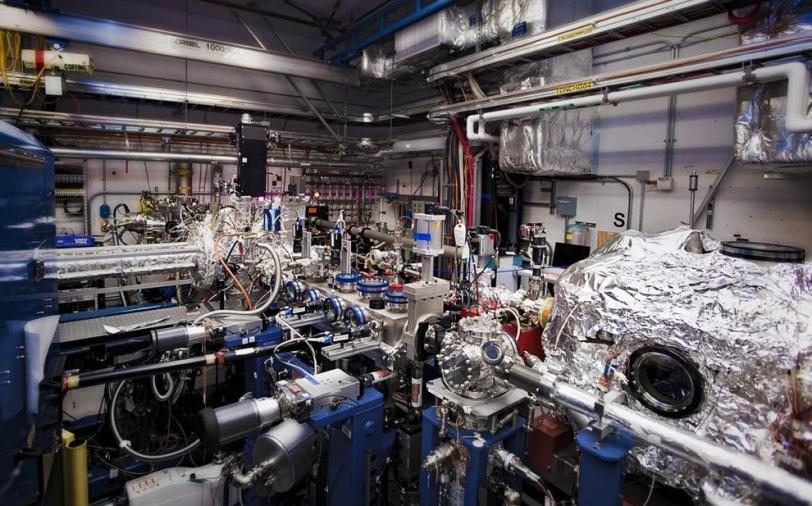
John Bozek, a staff scientist who manages the LCLS Soft X-ray Department, said the list of SLAC contributing authors is extensive and includes scientists involved in designing, installing and commissioning instruments and conducting the first experiments at the LCLS’s Atomic, Molecular and Optical Science experimental station (AMO), the first of six instrument stations built at LCLS.
Philip Bucksbaum, a SLAC professor of photon sciences and director of the Stanford PULSE Institute, a joint institute of SLAC and Stanford University, served as a guest editor for the issue, along with co-editors from Germany and Japan.
Bucksbaum and co-authors write, "A broad interdisciplinary research field has been formed" around XFELs, "which extends the borders of AMO science into biology, chemical dynamics and plasma physics."
The issue includes 34 papers on instrumentation and theoretical and experimental work at free-electron laser facilities, among them:
- FLASH in Hamburg, Germany, the world's first Extreme Ultraviolet (XUV) FEL.
- European XFEL (EXFEL), a multinational project under construction in Germany.
- SCSS in Harima, Japan, which began user operations in 2008.
- SACLA in Harima, Japan, which began operating in 2011.
- FERMI@Elettra in Italy, a free-electron laser that is expected to reach X-ray wavelengths.
Contact
For questions or comments, contact the SLAC Office of Communications at communications@slac.stanford.edu.
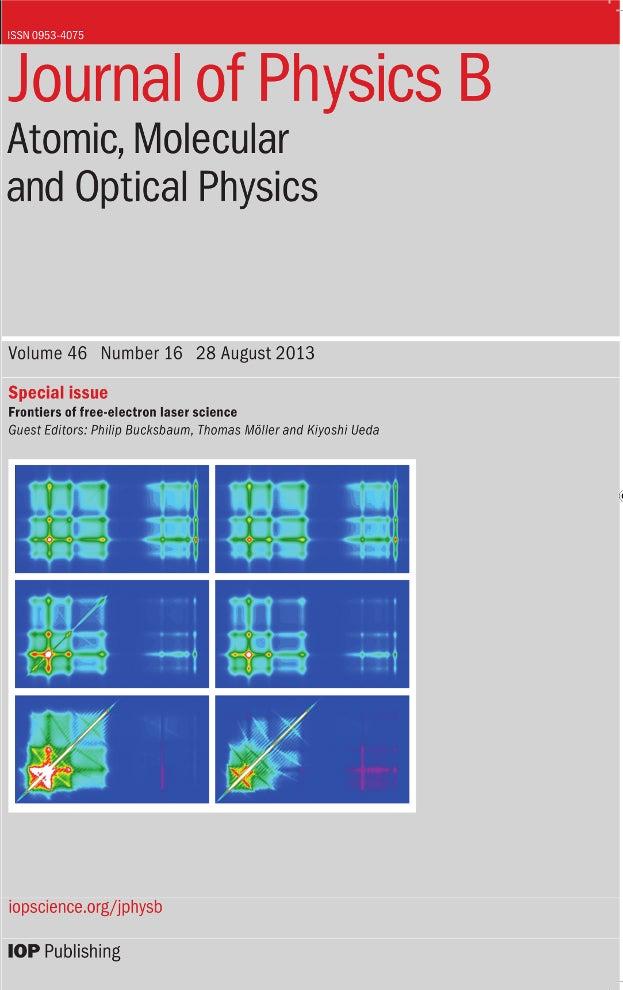
(O. Kornilov et al., 2013 Journal of Physics B: Atomic, Molecular and Optical Physics, doi:10.1088/0953-4075/46/16/164028)
Related stories